
How to figure out a lake you have never been to
Paper Maps
For you old school guys and gals, I'm sure you've seen the old paper maps like Hook-N-Line or Fishing Hot Spots, which you can still purchase the latter. These maps are a great source to study lakes as you can see them in full view without squinting at a computer screen. They will show you where all the points are, channel swings, creeks, drains, etc. Most will also have some marked areas where you can catch some fish.
Topographical maps like Google Earth
Using these types of tools on your computer or phone, you can find plenty of structure that bass should be on. You can also zoom in tight to view those areas in higher detail than a paper map. Also, most of these tools offer a way to view past lake levels, especially during droughts, so you can see the bottom when the water isn't covering it - showing you all the rock piles, points, ledges, sunken tires or boats that you should be focused on, which will definitely help you catch more bass.
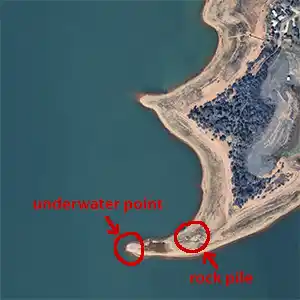
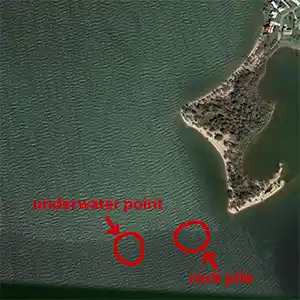
Example of an underwater point with rock pile on Lake Buchanan.
What to look for
Things you want to find are rock piles, brush piles, points, underwater points, ledges, channel swings and any other type of structure that will hold bass. Sometimes you can find where the grass is if a lake has some.
Time of Year
The number one thing to do when you start to dissect a lake is know what time of year it is when you will be fishing. Bass stage in different places depending on this.
Winter
If it is winter, they can be really deep, hanging where the water stays more of a constant temperature. Look for deep channel swings, possibly as deep as 40-60 feet of water depending on how cold it has been.
If there are some warmer days, they can move up shallow to feed and warm up. This time of year the temperature can change quickly up and down, so normally it's better fishing when the temperature is steady for about 3 days in a row.
Spring
In the spring, bass move in shallow, first on the points and then eventually towards the back of coves and creeks to get ready for the spawn. This is when you can catch the largest fish of the year, as the females are full of eggs and are eating up to get ready to spawn.
It's best this time of year to find some nice flats where these fish will spawn, and look for areas close by that have some depth to them - this is where the bass stage up and feed before moving onto the flats. You can generally catch bass in numbers and sometimes quite a few large ones. Once the spawn starts up, generally when the water temperatures reach a steady 60 degrees, you'll find those fish on the flats or shallow ledges, either on beds or cruising the shallows close to spawning.
Summer
As summer moves in, look for bass just outside the spawning flats on points or deeper ledges as they recuperate and gain their energy back. As they do, they feed more and more and come back shallow to hunt the other fish that spawn later, like shad, bluegill, tilapia and carp. At this time you can run the banks from the points and come across plenty of bass. It's best earlier in the day, but can be good later too before it gets really hot.
Once summer is rolling along and the days get hotter and hotter, this is the best time to fish the deeper coves and marinas, where the shad pile up in the shade and the bass school up good and feed on them. It's also sometimes best to fish at night, as the day brings too many people out and the lakes get crowded with recreational traffic.
Fall
Fall is a great time of year to catch some good fish. They're really starting to gain weight and will feed heavily as winter approaches, knowing their metabolism will slow way down and they won't eat as often in the colder months. You can find bass in the backs of coves feeding early, and in and around the mouths of coves and creeks throughout the day, so concentrate on those areas.
If you enjoyed this article, let me know by shooting me an email. Thanks!